
When Simple Beats Sophisticated
 6 min read
When Simple Beats Sophisticated
How does TiltFolio Balanced, a simple buy-and-hold portfolio of bonds, stocks, and gold, stack up against funds run by the world’s largest money managers?
On paper the comparison looks unfair. Bridgewater Associates manages more than $100 billion and employs hundreds of professionals. Their “All Weather” strategy, designed in the 1990s, was meant to handle almost any economic environment. Firms like AQR and Man AHL run related strategies under the broader label risk parity.
Over the past decade, TiltFolio Balanced, an allocation most people can hold in a brokerage account, still beat many of those institutional versions. Fees, leverage, and complexity explain more of that gap than marketing does.
The Origins of Risk Parity
The idea behind Bridgewater’s All Weather Fund was both elegant and practical. Instead of constantly trying (and usually failing) to predict the next market move, construct a portfolio of uncorrelated assets that balances risk across different environments.
The insight was that portfolio weights should not simply reflect capital allocations but risk contributions. Bonds, for example, are far less volatile than stocks or gold, so they receive a higher allocation to equalize their impact. That’s why TiltFolio Balanced allocates roughly half of its weight to government bonds, not out of optimism for bonds’ long-term returns, but because they act as stabilizers when stocks or gold are swinging.
Bridgewater was famously secretive about the precise recipe, but over time enough information leaked out to allow investors and academics to approximate All Weather’s design. The core idea (risk-balanced diversification) became the foundation for an entire category of institutional strategies.
Risk Parity’s Recent Stumbles
Despite decades of success, Bridgewater’s All Weather Fund and its peers have struggled in recent years. A Bloomberg article highlighted disappointing performance across the risk parity universe, raising questions about whether the approach still works.
Before writing off an entire philosophy, though, it’s worth digging into the numbers. To get a clearer picture, let’s compare four strategies over the decade from 2014 to 2023:
• HFR Risk Parity Index (10% volatility target)
• TiltFolio Balanced
• Global 60/40 portfolio (stocks and bonds only)
Here’s what $10,000 invested in each would have grown to after 10 years:
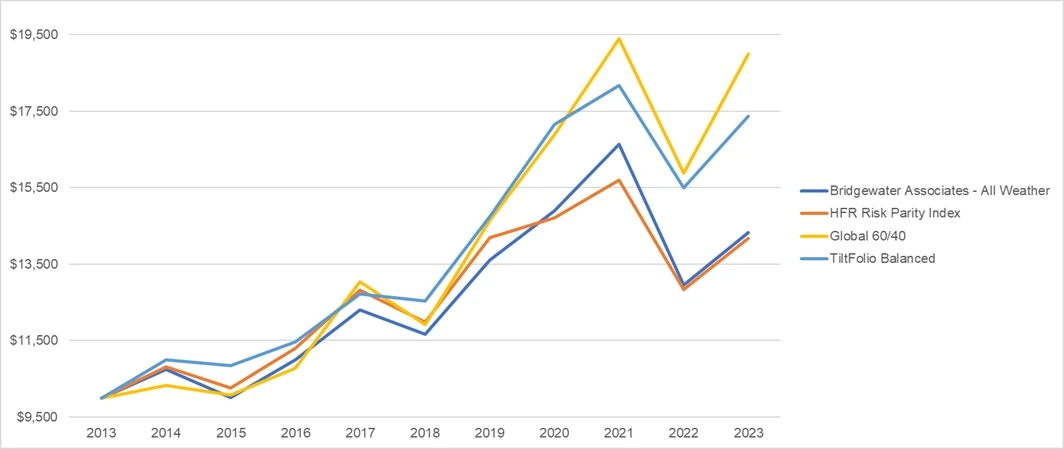
• HFR Risk Parity Index: $14,176 (3.6%/year)
• TiltFolio Balanced: $17,378 (5.7%/year)
• Global 60/40: $18,995 (6.6%/year)
These results are notable. Even without using leverage (a built-in advantage for institutional risk parity funds), TiltFolio Balanced came out comfortably ahead.
Addressing the “U.S. Bias”
Skeptics might argue that TiltFolio Balanced benefited unfairly from U.S. outperformance. After all, U.S. stocks and the dollar led the world during this period. To test this, we rebuilt TiltFolio Balanced using global stocks (MSCI ACWI) and global bonds (Bloomberg Global Aggregate) instead of their U.S.-only counterparts.
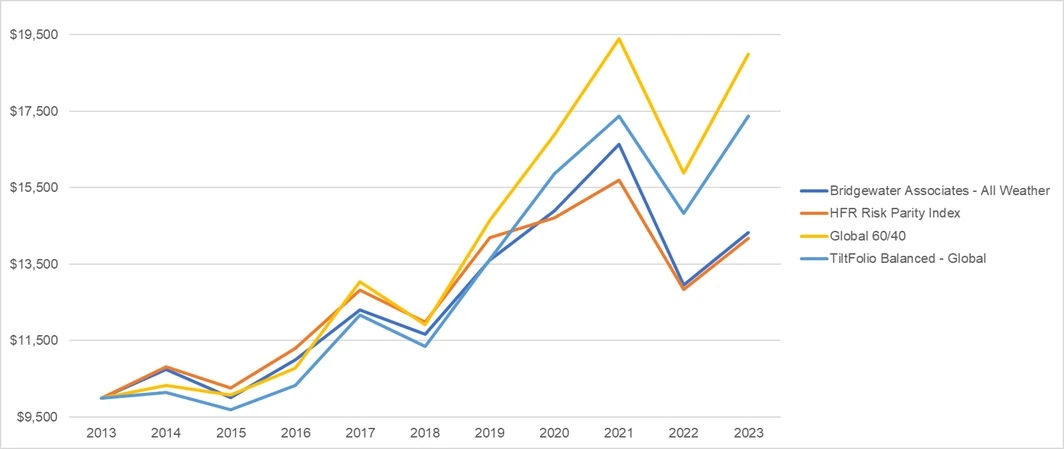
The global rebuild produced nearly the same return profile, still ahead of the institutional risk parity benchmarks.
Breaking Down Asset Performance
Looking under the hood, here’s how the individual components performed between 2014 and 2023:
• Global bonds (Bloomberg Aggregate): $14,888 (4.1%/year)
• Gold: $16,827 (5.3%/year)
The challenge for risk parity strategies becomes obvious: this was a decade dominated by equities. Any portfolio that spreads risk across multiple asset classes will lag during such an environment. TiltFolio Balanced and risk parity peers alike trailed the global 60/40 benchmark for this reason.
But this is by design. Risk parity strategies aren’t meant to beat stocks in a stock bull market; they’re meant to protect capital and compound steadily across environments.
What the Decade Actually Shows
All Weather’s recent stumbles do not kill risk parity as an idea. They do show how expensive and elaborate versions of it can lag a plain implementation.
Two points matter:
2. TiltFolio Balanced still beat the institutional risk parity benchmarks without leverage, exotic overlays, or a research army.
Risk parity is not dead. Overcomplication is. High fees, derivatives stacks, and constant “improvements” often leave less than a transparent 50/30/20 mix.
Why TiltFolio Balanced Works
TiltFolio Balanced is a clean risk-parity implementation: 50/30/20 bonds, stocks, and gold. That mix reduces volatility and drawdowns and keeps any one asset class from owning the whole return stream.
Investors do not need leverage or opaque models. They need a ruleset they can keep through cycles.
Over more than 50 years of backtested history, TiltFolio Balanced has shown:
• A maximum drawdown of approximately 20%, far less than equity markets
• Returns that trail pure stocks in strong bull markets, but with a smoother path that is easier to hold
Bridgewater criticism makes for easy headlines. The useful question is narrower: can you capture the diversification benefit without paying for complexity that does not improve after-fee results? For many investors, a simple, transparent mix is the better answer.
How TiltFolio Works Series
This post is part of the “How TiltFolio Works” series. Explore all posts in the series:
- TiltFolio Explained: A Smarter Alternative to 60/40 Portfolios
- Explaining TiltFolio Through Car Brands
- Why the Modern World Needs TiltFolio
- Why TiltFolio Balanced Is the Foundation
- The Ancient Origins of Portfolio Diversification
- TiltFolio Balanced as a Market Barometer
- When Simple Beats Sophisticated
- Decades of Perspective: What TiltFolio Balanced Teaches Us About the Future
- Building a Simple Trend-Following System
- Beyond Moving Averages: Why Volatility Trends Matter More Than You Think
- How TiltFolio Adaptive Differs From Traditional Trend-Following
- Will Trend-Following Keep Working?
- When Trend-Following Underperforms
- How to Avoid Curve-Fitting in Trend-Following
- The “Secret” to the Best Risk-Adjusted Returns: Correlations
- Combining Balanced and Adaptive: A Practical Portfolio Mix
- TiltFolio’s Main Edge: Reliability That Compounds
- How to Stay Committed to an Investment Plan