Why Gold Lost Its Monetary Role
 5 min read
Why Gold Lost Its Monetary Role
In Why Monetary Systems Change and Gold’s Role as a Monetary Yardstick, I argued that money is a common yardstick, that gold became history’s preferred version of that yardstick, and that monetary systems tend to break when fiscal pressure overwhelms the existing rules.
That leaves a sharper historical question: if gold worked as a monetary anchor for centuries, why did societies leave it behind?
Not because gold suddenly stopped functioning. Because gold imposed limits, and modern governments preferred a system that did not.
Gold and the Age of Scarcity
For most of history, relatively few people held large amounts of money. Economic life was local. Many people worked the land, produced for their own use, or paid taxes and rents in labour or crops. Money existed, but it was not yet the center of daily life for most households.

In earlier centuries, money was largely confined to the nobility and commercial classes. Peasants were often paid in kind, through food, lodging, labour obligations, or a share of the harvest, rather than in coin.
Industrialisation, urbanisation, banking, and international trade changed that. Wages were paid in cash. Savings moved into banks. Credit expanded. Financial contracts became ordinary. Today almost everyone is inside the monetary system. In that sense, money became more democratic.
Money also became less scarce. After gold stopped constraining issuance, the supply of money and credit grew far faster than under earlier regimes.
That matters because money is not the same thing as capital.
Capital is productive capacity: businesses, factories, infrastructure, technology, skills, and investments that generate future income. Creating more money does not automatically create more of those things. It creates more claims on what already exists. That distinction hardened after gold lost its official monetary role.
The Discipline Governments Grew Tired Of
Under the classical gold standard, currencies were tied to a scarce physical asset. Expand money too aggressively and you risked losing gold reserves. The system was imperfect. Wars, crises, and major gold discoveries still moved prices. Over long stretches, though, inflation stayed low and monetary expansion stayed constrained.
That discipline was gold’s strength. It was also its political liability.
Governments often want to spend more than tax revenues allow, especially in wars, recessions, and financial crises. Gold limited that option. So convertibility was suspended when fiscal strain got severe enough: England during the Napoleonic Wars, many countries during the First World War, and repeatedly afterward. The suspensions were usually sold as temporary. Returning proved harder than leaving.
Britain after the First World War shows why. Wartime money and credit had already expanded. In 1925, Winston Churchill restored gold convertibility at the pre-war exchange rate. The aim was confidence. The result was deflation, because prices and wages had already adjusted upward. Churchill later called it one of the greatest mistakes of his career. That was not gold failing. It was an attempt to restore an earlier monetary relationship after years of wartime inflation. I covered that episode in more detail in Why Monetary Systems Change.
From Depression Compromise to Nixon
The Great Depression pushed opinion further toward flexibility. With falling prices, bank failures, and mass unemployment, policymakers wanted room to expand money and credit without a hard gold ceiling.
Bretton Woods tried a middle path after the Second World War: the dollar stayed linked to gold, and other currencies tied themselves to the dollar. Some of gold’s discipline remained. More flexibility existed than under the classical standard. For a while it held.
Then the same pressure returned. By the late 1960s the United States was funding Vietnam and expanding domestic programmes while overseas dollar claims grew larger than U.S. gold reserves could realistically redeem. In 1971, President Richard Nixon suspended dollar convertibility into gold. Bretton Woods ended. The modern fiat era began.
Without a physical anchor, money and credit could expand much faster. Issuance was guided by policy, banking, inflation targets, and models rather than by a scarce metal.
A World with More Money
Modern economies hold far more money than they did a century ago. Part of that is progress: broader banking access, higher incomes, deeper markets, wider participation in economic life.
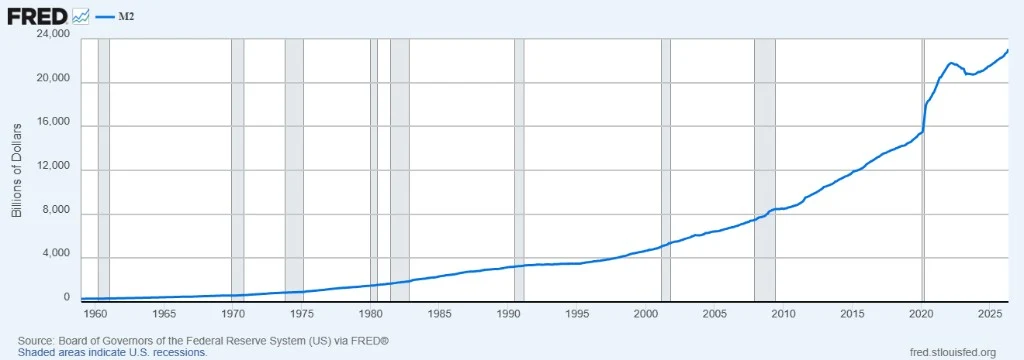
U.S. M2 money supply from FRED, Federal Reserve Economic Data, St. Louis Fed
It also changes how markets behave. Once an economy already has enough money for ordinary transactions, additional money does not automatically build additional capital. A large share becomes claims on existing assets: equities, bonds, real estate, commodities, and other investments. That is one reason asset prices sit at the center of modern economic life.
It also helps explain why gold still matters. It is no longer the world’s official monetary anchor. It remains a market reference for how investors judge the long-term stability of money itself.
What This Means for Investors
Gold lost its official monetary role because societies preferred flexibility over constraint, not because the metal stopped working as an anchor. Whether that trade-off has been worth it is still debated.
For investors, the practical question is narrower: how do changing monetary conditions redirect capital?
That relationship sits under TiltFolio’s design. Rather than trying to call every policy decision, the process adapts as money and capital move. TiltFolio Balanced keeps diversified exposure across assets that respond differently when monetary conditions shift. TiltFolio Adaptive uses trend-following to follow strength as it appears.