Gold's Role as a Monetary Yardstick
 9 min read
Gold’s Role as a Monetary Yardstick
In our previous article, Why Monetary Systems Change, I argued that money functions as society’s yardstick. It allows people to compare prices, write contracts, save for the future, and coordinate economic activity across time.
That naturally raises another question.
If money is a yardstick, what should that yardstick be?
Throughout history, societies experimented with many different answers. Over time, however, one asset emerged again and again as the preferred monetary yardstick: gold.
Understanding why helps explain not only the history of money, but also why gold continues to play an important role in diversified investment portfolios today.
The Long Search for a Monetary Yardstick
History is full of monetary experiments.
Ancient Rome used salt so extensively that it gave rise to the word salary. Other societies relied on shells, spices, silver, copper, large carved stones, and countless other objects. More recently, cigarettes became money in prisoner-of-war camps, while Levi’s jeans circulated as an unofficial currency in the former Soviet Union.
Despite these diverse beginnings, many major economies gradually converged on gold.
Gold possessed a unique combination of characteristics that made it well suited for monetary use. It was scarce, durable, portable, easily recognizable, difficult to counterfeit, and its supply increased only gradually over time.
In 1717, Sir Isaac Newton, then Master of the Royal Mint, fixed the relationship between gold and silver in Britain. Although Britain formally remained on a bimetallic standard for some time, Newton’s decision helped lay the foundations for the modern gold standard that many countries later adopted.
Gold was not chosen because it generated income or produced goods.
It was chosen because it proved to be an exceptionally stable yardstick.
A Remarkably Stable Measuring System
One of the most striking pieces of evidence supporting gold’s historical role comes from England’s long-run price history.
Studies of wholesale prices over several centuries show that under both the silver-gold bimetallic standard and the later gold standard, prices remained remarkably stable over long periods.
Between the early eighteenth century and the early twentieth century, a period encompassing the Industrial Revolution, enormous technological progress, and major wars, the overall price level changed surprisingly little.
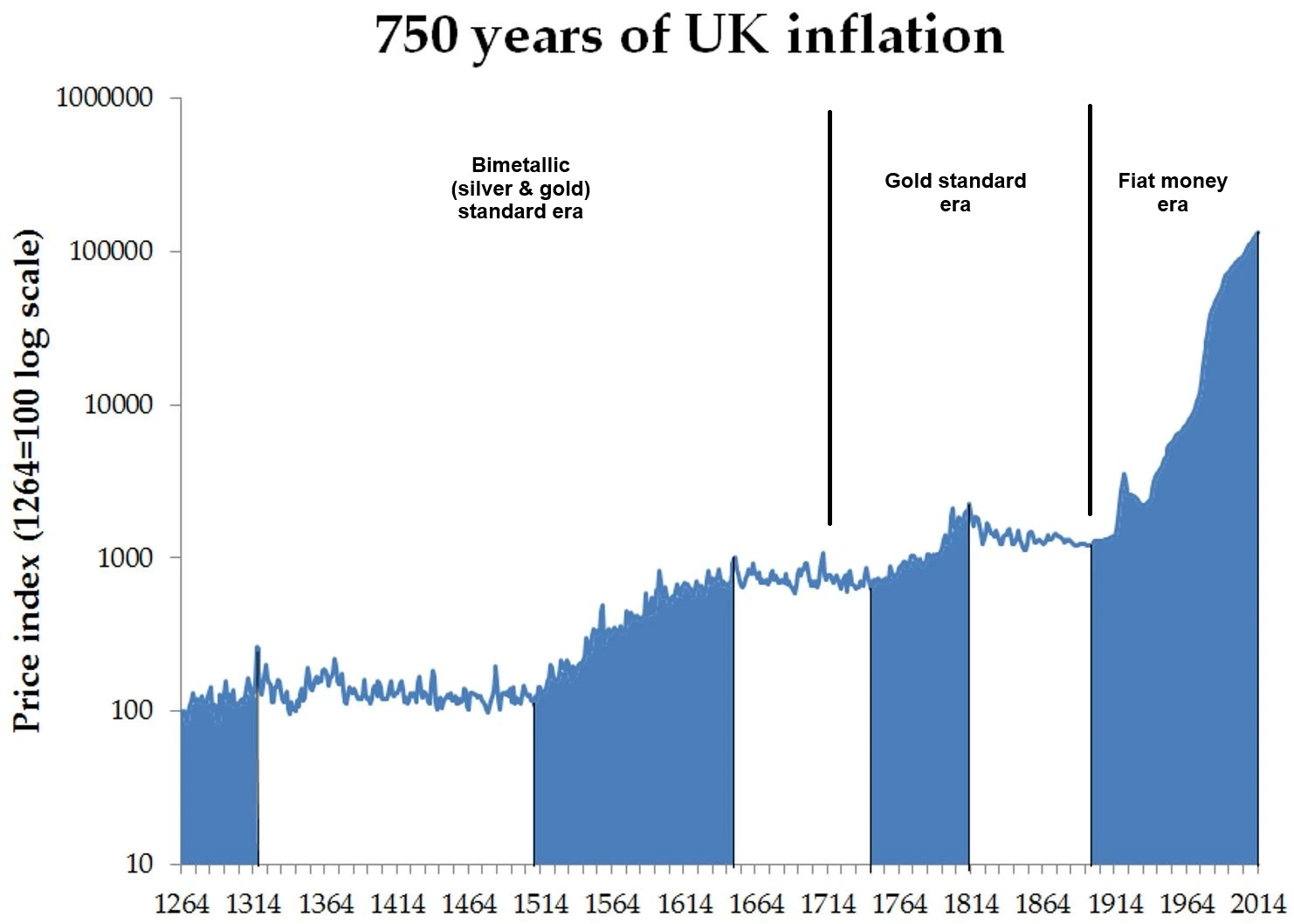
This chart illustrates the price stability achieved under the gold and bimetallic standards, showing how prices remained remarkably stable for centuries despite major historical events.
Inflation certainly occurred during individual years, and discoveries of new gold supplies occasionally affected prices. But unlike the persistent inflation experienced under modern fiat systems, prices generally tended to return toward their long-run average.
For households, businesses, and investors, this stability mattered enormously.
A contract signed today was far more likely to retain its purchasing power years into the future. Entrepreneurs could make long-term investments with greater confidence that the unit of account itself would remain relatively stable.
How the Gold Standard Worked
Under a gold standard, managing “monetary policy” was refreshingly straightforward. The currency itself was defined as a fixed weight of gold, redeemable on demand. Convertibility kept money tethered to that yardstick. The central bank could reinforce the same signal with interest rates and bonds.
If too much currency was in circulation, gold’s market price would rise above the official mint price. It then became profitable to present notes to the monetary authority, take gold at the cheaper official rate, and sell it in the market. Gold left the vaults and cash was retired. The central bank could speed that tightening by raising its discount rate and selling bonds, soaking up still more money.
If currency was too scarce, gold’s market price would fall below the official price. It then became profitable to buy gold in the market and sell it to the authority at the higher official rate. Gold entered the vaults and cash was issued. The central bank could speed that easing by lowering its discount rate and buying bonds, putting more cash back into the economy.
Shipping, insurance, and interest costs created a small band around the official price, often less than 1%, within which gold did not move. Beyond those “gold points,” the flows began.
That was it. A rules-based mechanism, not a discretionary one. The system worked because it removed most human judgment. Gold provided discipline.
Why We Moved Away From Gold
The twentieth century increasingly favored flexibility.
Large-scale wars, expanding government responsibilities, and repeated financial crises all encouraged policymakers to seek greater control over money and credit.
The Bretton Woods system attempted to preserve some connection to gold after the Second World War, but in 1971 the United States suspended the dollar’s convertibility into gold, effectively ending the international gold standard.
Since then, monetary systems have been based entirely on fiat currencies.
This change gave governments and central banks far greater freedom to influence interest rates, expand credit, and respond to economic shocks.
Whether this has ultimately produced a better monetary system remains the subject of ongoing debate.
Gold’s Role Today
Although gold no longer serves as the world’s official monetary yardstick, it continues to occupy a unique position within the financial system.
Unlike fiat currencies, gold cannot be created through policy decisions. Its supply grows slowly and predictably, making it fundamentally different from government-issued money.
For this reason, many investors continue to view gold as a monetary asset rather than simply another commodity.
Since the collapse of Bretton Woods in 1971, gold has appreciated substantially over the long run. While many factors influence its price, including real interest rates, investor sentiment, geopolitical uncertainty, and inflation expectations, its performance has reinforced its reputation as an asset that often benefits when confidence in fiat currencies weakens.
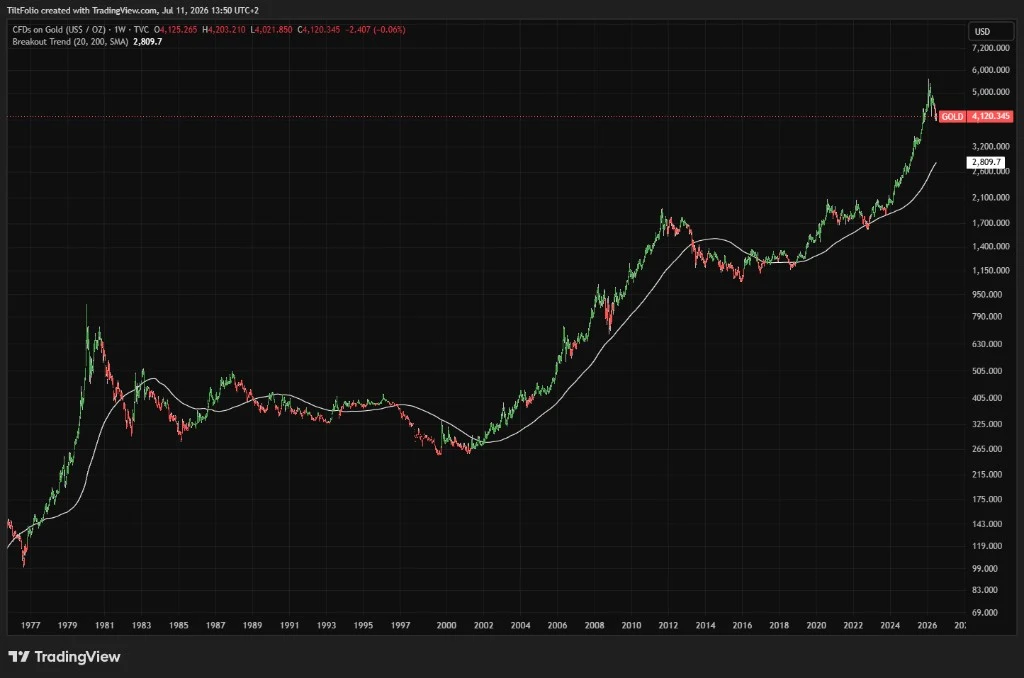
Gold price in USD per ounce, weekly chart from TradingView
Gold as a Hedge, Not a Store of Value
That pattern suggests a different way of thinking about gold.
Rather than viewing it as a passive store of value, it may be more accurate to see it as a long-dated put option on the current monetary system.
A put option pays off when the price of the underlying asset falls. In this case, the underlying asset is confidence in fiat money itself. When investors begin to question whether currencies will retain their purchasing power, whether governments will restrain deficits, or whether central banks can maintain stability without creating new imbalances, gold tends to rise. When confidence returns, gold often falls back.
This is where the put option idea connects back to gold’s historical role as a yardstick. Under the gold standard, gold literally defined the unit of account. It was the fixed reference against which money itself was measured. Today, gold no longer sets the official yardstick. But markets still use it as an informal yardstick for the health of the monetary system. When investors fear the fiat yardstick is bending, gold reprices upward. When confidence in that yardstick returns, gold settles back. The put option and the yardstick are two ways of describing the same phenomenon: gold rises when the official measure of value begins to lose credibility.
That is why gold behaves less like a savings account and more like monetary insurance. Like any insurance policy, it has a cost. During long periods when the financial system appears stable, holding gold can feel unrewarding. Stocks may rally, bonds may deliver steady returns, and gold may drift sideways or decline. Investors are effectively paying a premium for protection they are not yet using.
This also helps explain gold’s volatility. Unlike stocks or bonds, gold produces no earnings, coupons, or cash flows. Its price is driven largely by changing expectations about the future of money itself. When those expectations shift quickly, gold can move sharply in either direction. It is not volatile because gold has become less reliable as a metal. It is volatile because it functions as a hedge against an uncertain monetary future.
Gold does not generate income, and it can underperform for many years at a time. But its role has never depended on producing cash flows. Its value lies in behaving differently from most financial assets.
What This Means for TiltFolio
This is why gold remains an important component of TiltFolio’s investment philosophy.
TiltFolio Balanced maintains a permanent 20% allocation to gold because we believe every diversified portfolio should include assets that respond differently to changing monetary and economic conditions.
Gold is not expected to outperform every year.
In fact, there will be extended periods when equities or bonds produce significantly better returns.
But diversification is not about owning only the best-performing asset. It is about building a portfolio that remains resilient across many different environments.
TiltFolio Adaptive approaches gold differently.
Rather than maintaining a permanent allocation, it allows market trends to determine when gold deserves a larger role. During periods when investors increasingly seek monetary protection, gold often develops powerful sustained trends. When those trends fade, Adaptive systematically reallocates capital elsewhere.
The two systems therefore share the same philosophy while implementing it differently.
Conclusion
Gold earned its place in history not because it was magical or inherently more valuable than every other asset.
It earned that role because, for centuries, it provided societies with the most stable monetary yardstick they had ever known.
Today’s financial system operates under very different rules.
Whether one prefers the flexibility of fiat money or the discipline of a commodity-backed system, one reality remains unchanged: capital continually responds to changing monetary conditions.
For investors, the objective is not to predict every change in the monetary system.
It is to build a disciplined portfolio capable of adapting as those changes reshape financial markets.
Even in a fiat world, gold remains the yardstick investors reach for when they want to measure whether money itself is still trustworthy. That is why gold remains an important part of the TiltFolio philosophy: not as a bet on catastrophe, but as standing insurance against the possibility that the monetary yardstick may once again lose credibility.
In the next article, I’ll look at why gold lost its official monetary role, and why that was a preference for flexibility rather than proof that gold had stopped working.